AI in Healthcare: Transforming Patient Care
Artificial intelligence is reshaping medicine. From diagnosis to drug discovery, AI is creating a future of more precise, personalized, and accessible healthcare. Its role is not to replace physicians, but to amplify human expertise.
About the Author
Mauricio Guadamuz MD, MSc, MBA, MIDM, is a physician and researcher exploring the intersection of artificial intelligence and medicine. Alongside his scientific work, he is also the author of Quantum Dreams, an ambitious science-fiction saga that blends neuroscience, quantum theory, and dream cartography. His dual journey—medicine and storytelling—reflects a single mission: to expand how we imagine the future of health, technology, and the human mind.

How AI Supports Medicine Today
Sharper Diagnosis → AI detects subtle patterns in medical images and data, enabling earlier and more accurate diagnoses.
Personalized Treatment → Algorithms predict patient responses, guiding tailored therapies.
Virtual Care Companions → Chatbots and assistants offer 24/7 support, scheduling, and remote monitoring.
Faster Drug Discovery → AI screens millions of compounds, accelerating the path to life-saving treatments.
Operational Efficiency → Hospitals use AI to optimize logistics and free up staff for patient care.
Predictive Analytics → Algorithms flag patients at risk of chronic conditions, enabling proactive interventions.
AI: The Diagnostic Lens
Refining precision: AI algorithms analyze medical images and data to detect subtle patterns, leading to earlier and more accurate diagnoses.
Personalized Medicine’s AI Compass
Tailored treatments: AI helps predict individual patient responses to therapies, enabling customized care plans for optimal outcomes.
AI: The Virtual Care Companion
24/7 support: AI-powered chatbots and virtual assistants provide patients with instant access to information, appointment scheduling, and remote monitoring
Drug Discovery’s AI Accelerator
Speeding innovation: AI analyzes vast datasets to identify potential drug targets and predict the efficacy of new compounds, shortening the path to life-saving treatments
AI: The Operational Efficiency Engine
Streamlining workflows: AI automates administrative tasks, optimizes resource allocation, and improves hospital logistics, freeing up healthcare professionals to focus on patient care
Predictive Analytics’ AI Foresight
Anticipating needs: AI algorithms analyze patient data to identify those at risk of developing chronic conditions or experiencing adverse events, enabling proactive interventions
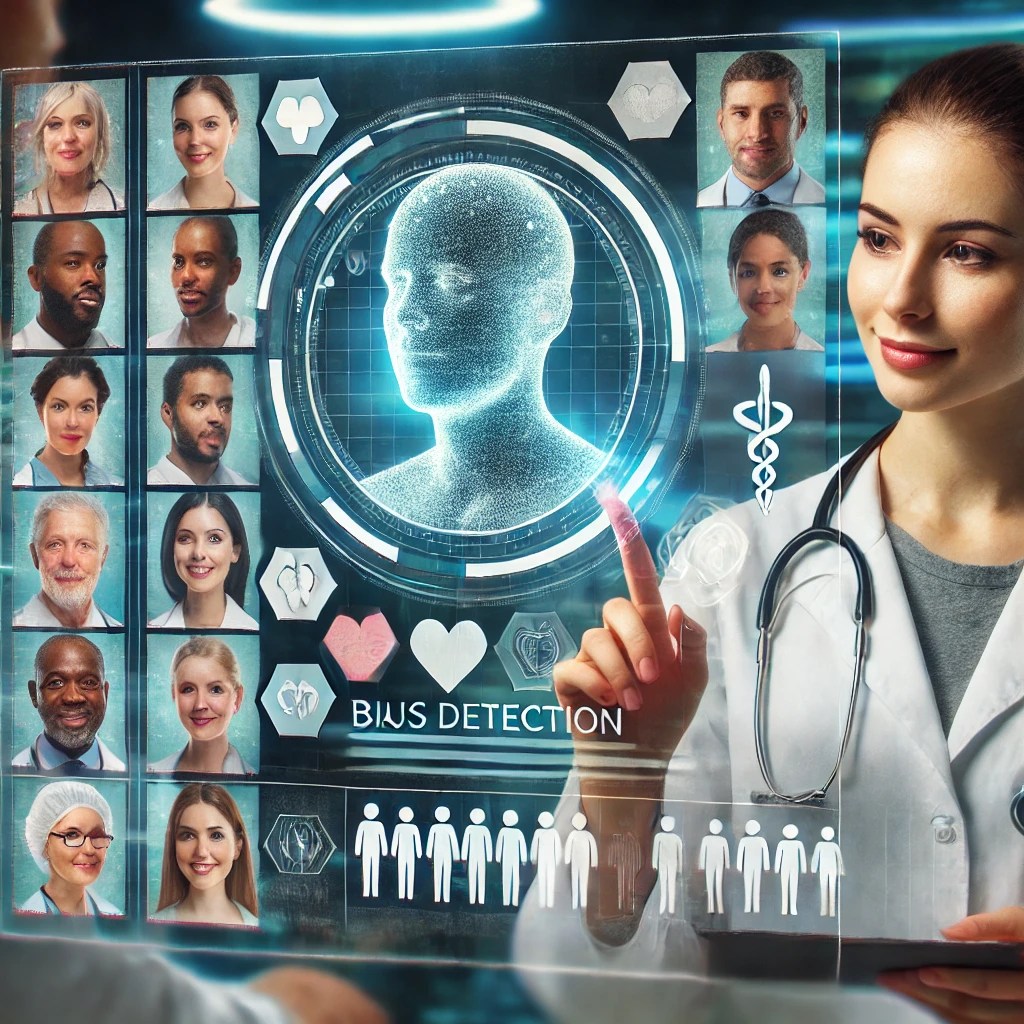
Bias in AI is a Medical Risk
- AI models learn from historical data, which means they can inherit biases from incomplete or unbalanced datasets. If not properly trained, AI can produce inaccurate diagnoses or treatment recommendations, disproportionately affecting underrepresented populations. Addressing this bias is a critical challenge in AI-driven medicine.
- AI models are only as good as the data they are trained on. If the training datasets lack diversity—whether in terms of ethnicity, gender, socioeconomic status, or disease prevalence—the AI can develop biases that lead to skewed or inaccurate medical recommendations. For example, studies have shown that some AI-driven dermatology models perform well on lighter skin tones but struggle to detect conditions in darker skin tones due to an underrepresentation of diverse images in training data. This kind of bias can result in delayed or incorrect diagnoses, ultimately impacting patient outcomes.
- Beyond clinical diagnostics, bias in AI extends to predictive analytics, treatment recommendations, and even hospital resource allocation. If an AI model is trained on historical healthcare data that reflects systemic inequalities, it may reinforce them rather than correct them. For instance, algorithms used to prioritize patient care may inadvertently disadvantage marginalized groups due to biases in past medical records. The solution lies in carefully curating diverse datasets, implementing bias detection methods, and ensuring that AI remains a tool that supports equitable healthcare rather than perpetuating disparities.

AI is Already Creating New Drugs
- The traditional drug discovery process is notoriously slow and expensive, often taking over a decade and billions of dollars to bring a new drug to market. AI is revolutionizing this process by rapidly analyzing vast datasets, predicting molecular interactions, and even designing entirely new drug compounds. Machine learning algorithms can screen millions of chemical structures in a fraction of the time it would take humans, identifying potential drug candidates with higher precision. Companies like Insilico Medicine and BenevolentAI have already leveraged AI to design novel drugs, some of which are entering clinical trials at an unprecedented speed.
- One of the most remarkable applications of AI in drug development is its ability to repurpose existing drugs for new indications. Instead of starting from scratch, AI models can analyze genetic, clinical, and molecular data to predict whether an approved drug could be effective for a different disease. This was particularly evident during the COVID-19 pandemic when AI-driven approaches helped identify existing medications with potential antiviral properties, accelerating clinical trials and treatment options. By reducing the time required to discover and test new therapies, AI is helping to address urgent medical needs more efficiently.
«In the era of digital transformation, understanding AI is no longer optional for healthcare professionals—it is essential. AI is not here to replace physicians or researchers; it is here to augment our capabilities, accelerate drug discovery, enhance diagnostics, and optimize patient care. Those who embrace AI will lead the future of medicine, while those who ignore it risk being left behind.»
Mauricio Guadamuz MD. MSc. MBA. MIDM
Editor
Read my articles
Quantum Dreams. My Book
What if dreams were not fleeting images of the night, but a vast cartography—an infinite world where memory, desire, and creation intersect?
Quantum Dreams unfolds at the edge of science and imagination, following Leo, a physician haunted by questions of consciousness; Lyra, an intelligence born of quantum code yet struggling for coherence; and Erem, a dream-reader who carries forgotten voices in his own skin. Together, they cross the shifting corridors of the Mundo de los Sueños Cuánticos (MSQ), where every echo is a debt, every silence a law, and every signature a risk of dissolution.
As they delve deeper, they encounter Somnus, the regulating force that governs the architecture of dreams. Somnus is not a myth, but a subject that speaks and inscribes rules upon those who dare to trespass. Each step closer to the heart of the MSQ draws them into conflicts of authorship, identity, and survival:
- Can a dream truly belong to anyone?
- Who holds the right to shape the unconscious?
- And what happens when the map begins to rewrite the cartographer?
Merging neuroscience, quantum theory, and narrative poetics, Quantum Dreams is both a journey and an inquiry. It invites the reader to imagine sleep not as absence, but as a frontier of discovery—one where the boundaries between human and machine, dream and wakefulness, self and other, begin to blur.
Far from a conventional science-fiction novel, this work builds a literary universe that questions ownership of dreams and the architecture of consciousness itself. It is a story of exploration and peril, but also a meditation on the fragile line that separates the voices we inherit from the voices we create.
 aiglobalhealth.blog